Plus Tutoring
Helping tutors make informed scheduling decisions
- Role
- Product Design Intern
- Timeline
- In progress
- Skills
- Scheduling & Calendar UX, Complex Workflow Design, AI-Assisted Design
- Team
- Brittany Jain (Design Mentee)Bill Guo (Design Manager)
Project Overview
Problem
Tutors are frequently asked to cover sessions at the last minute. However, the existing scheduling system uses hard restrictions that prevent tutors from signing up for sessions that overlap with existing commitments.
Goal
Design a scheduling experience that reduces accidental overlapping sign-ups while preserving flexibility for legitimate coverage situations. The solution needed to:
Prevent mistake-driven scheduling conflicts.
Support last-minute coverage requests.
Keep tutors informed of potential overlaps.
Research
Understanding the existing workflow
To understand how tutors and supervisors managed overlapping sessions, I reviewed current scheduling flows and analyzed common conflict scenarios. I found that overlapping sessions generally fell into two categories:
Intentional overlaps
Situations where tutors knowingly accepted overlapping commitments because coverage was urgently needed and/or the overlap was brief.
Unintentional overlaps
Situations where tutors overlooked scheduling conflicts and later submitted call-off requests after realizing they could not attend both sessions.
Opportunity Statement
“How might we help tutors make informed scheduling decisions while preserving flexibility for legitimate coverage scenarios?”
Strategy
Reframing the experience
The existing system treated all scheduling conflicts the same way: by blocking tutors from signing up. However, our research revealed that not all overlaps carry the same level of risk.
A five-minute transition between sessions is fundamentally different from a forty-five-minute scheduling collision.
Rather than designing around rigid restrictions, I focused on creating a system that helps tutors understand conflicts and make informed decisions.
Design principles
Make conflicts visible
Surface overlaps early in the workflow through clear visual indicators, so tutors understand potential issues before committing.
Quantify severity
Communicate how serious a conflict is — from a minor 5-minute transition to a major overlap — so tutors can quickly assess risk.
Support decision-making
Give tutors enough context to weigh trade-offs and make informed decisions, while preserving flexibility for legitimate coverage.
Mapping the conflict landscape
To understand the full scope of the problem, I mapped every scheduling scenario involving:
- Recurring sessions
- One-time fill-ins
- Multiple session selections
- Mixed recurring and one-time conflicts
This resulted in more than 18 unique overlap scenarios. Rather than designing for every edge case, I grouped similar situations into a smaller set of reusable patterns.
18 scenarios
6 patterns
Creating a conflict framework
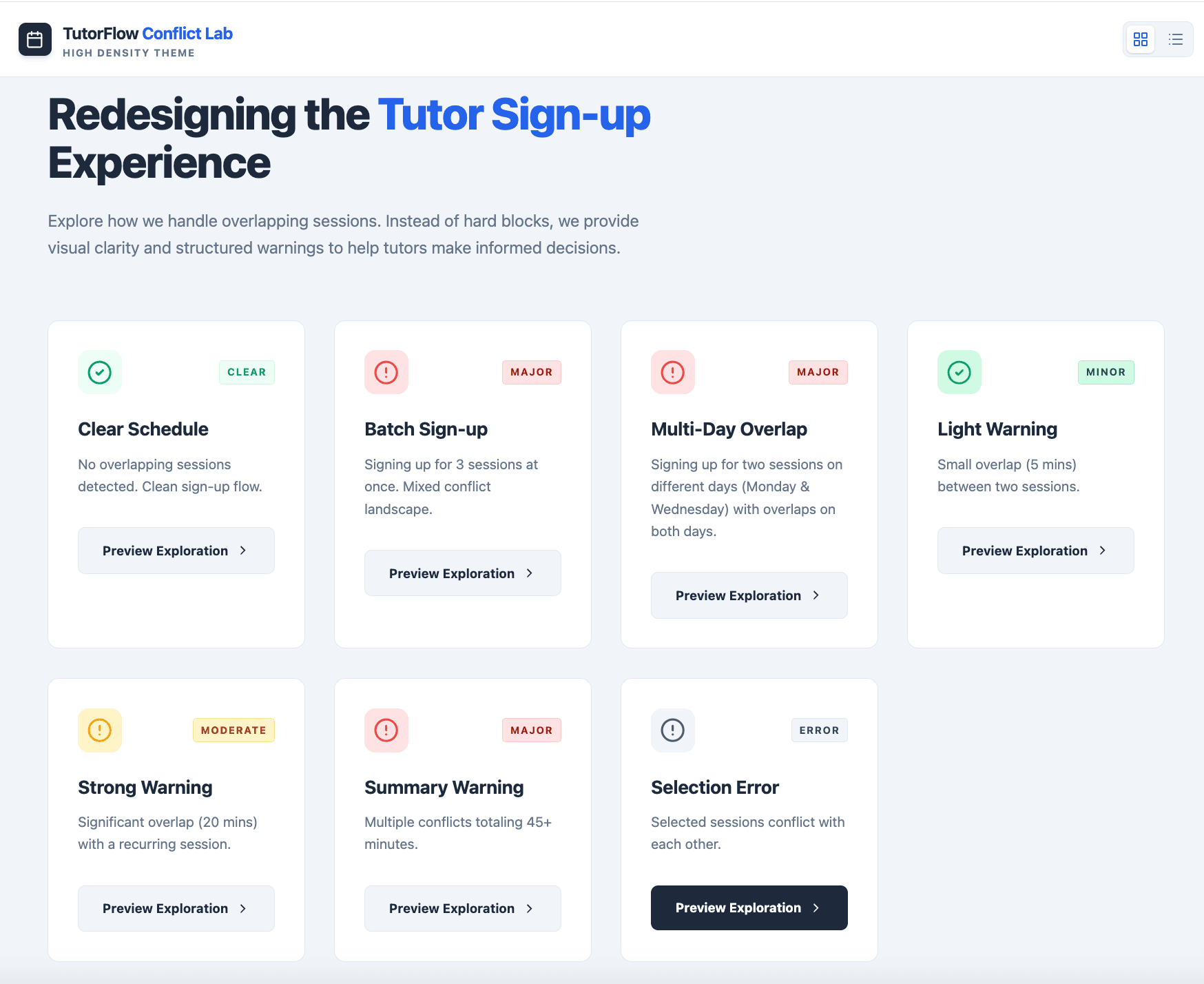
After reviewing overlap duration, number of conflicts, and sign-up behavior, I grouped scenarios into six warning states.
Clear schedule
No overlapping sessions detected. Tutors move through a standard sign-up flow without interruption.
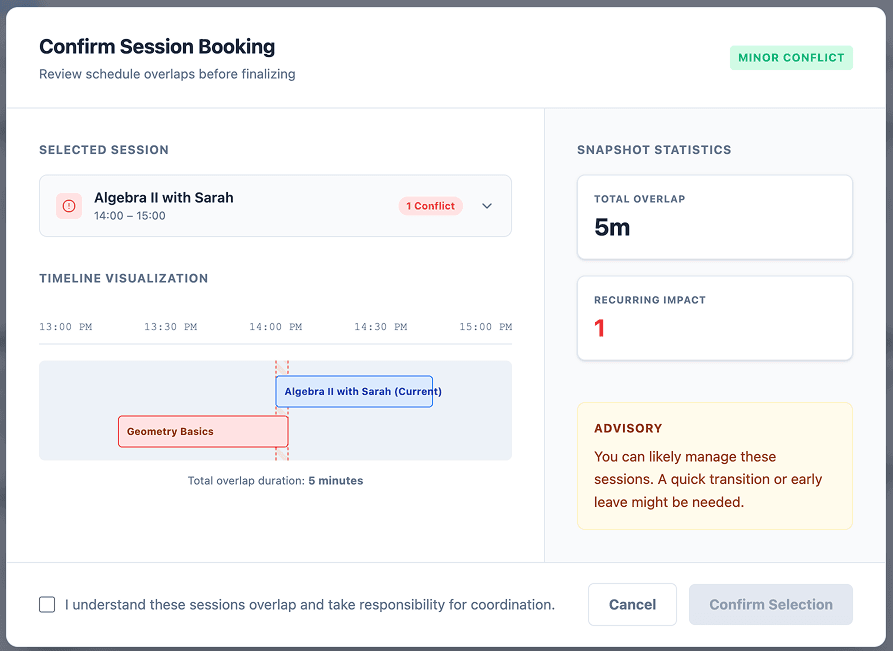
Light warning
Used when a tutor encounters a small overlap (typically under 20 minutes).
- 5-minute transition between sessions
- Small overlap with a recurring commitment
- Brief conflict with a one-time fill-in
Strong warning
Used when a conflict represents a meaningful scheduling risk.
- 20-minute overlap with a recurring session
- Significant conflict with an existing commitment
Summary warning
Used when multiple conflicts exist simultaneously.
- Multiple recurring conflicts
- Multiple one-time conflicts
- Mixed recurring and one-time conflicts
Instead of presenting multiple individual alerts, the system summarizes all affected sessions in a single view.
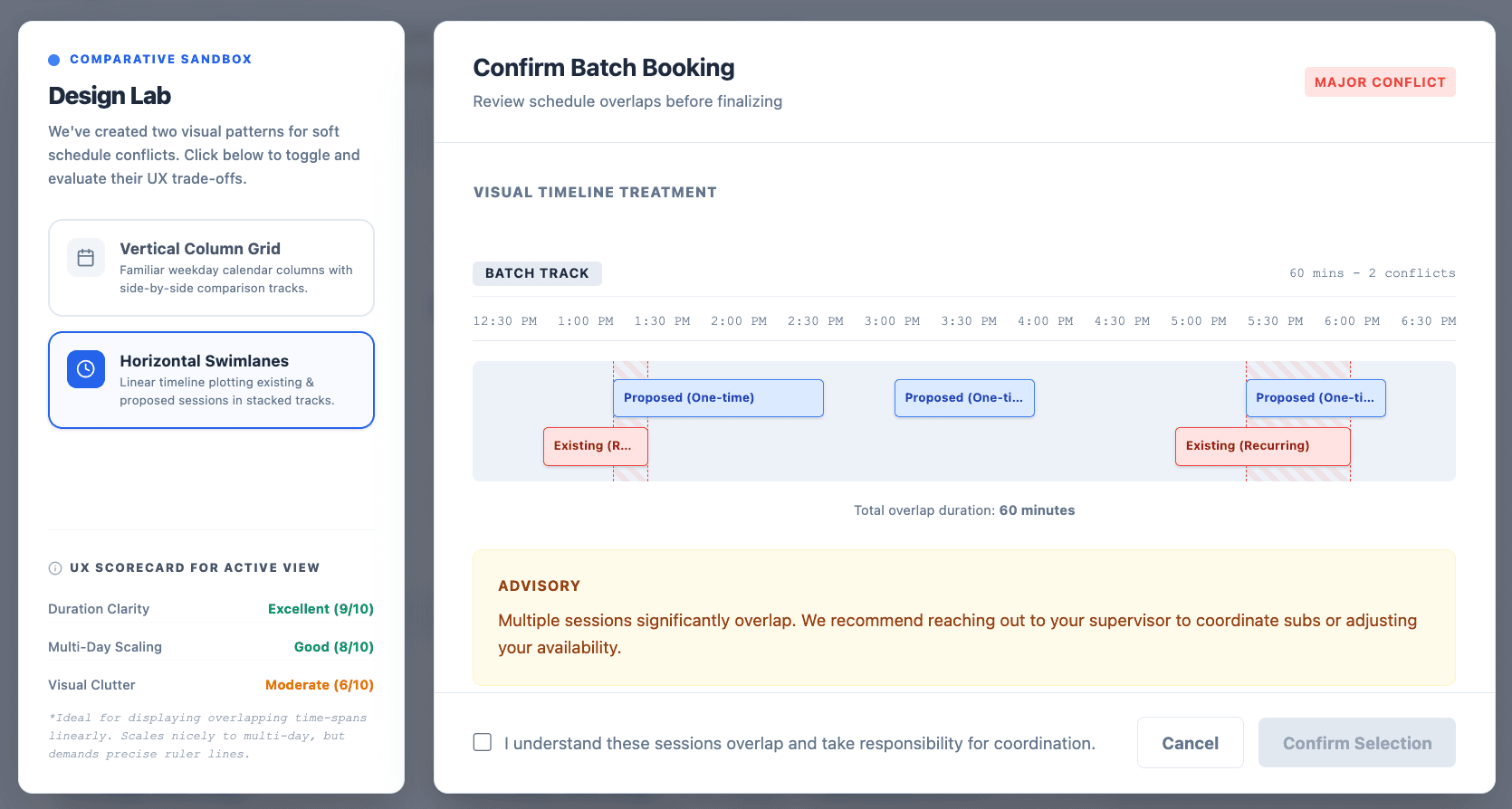
Batch warning
Used when tutors sign up for multiple sessions at once.
- Three fill-in sessions selected simultaneously
- Conflicts spread across several sessions or dates
The system identifies which selections create conflicts and summarizes risk across the batch.
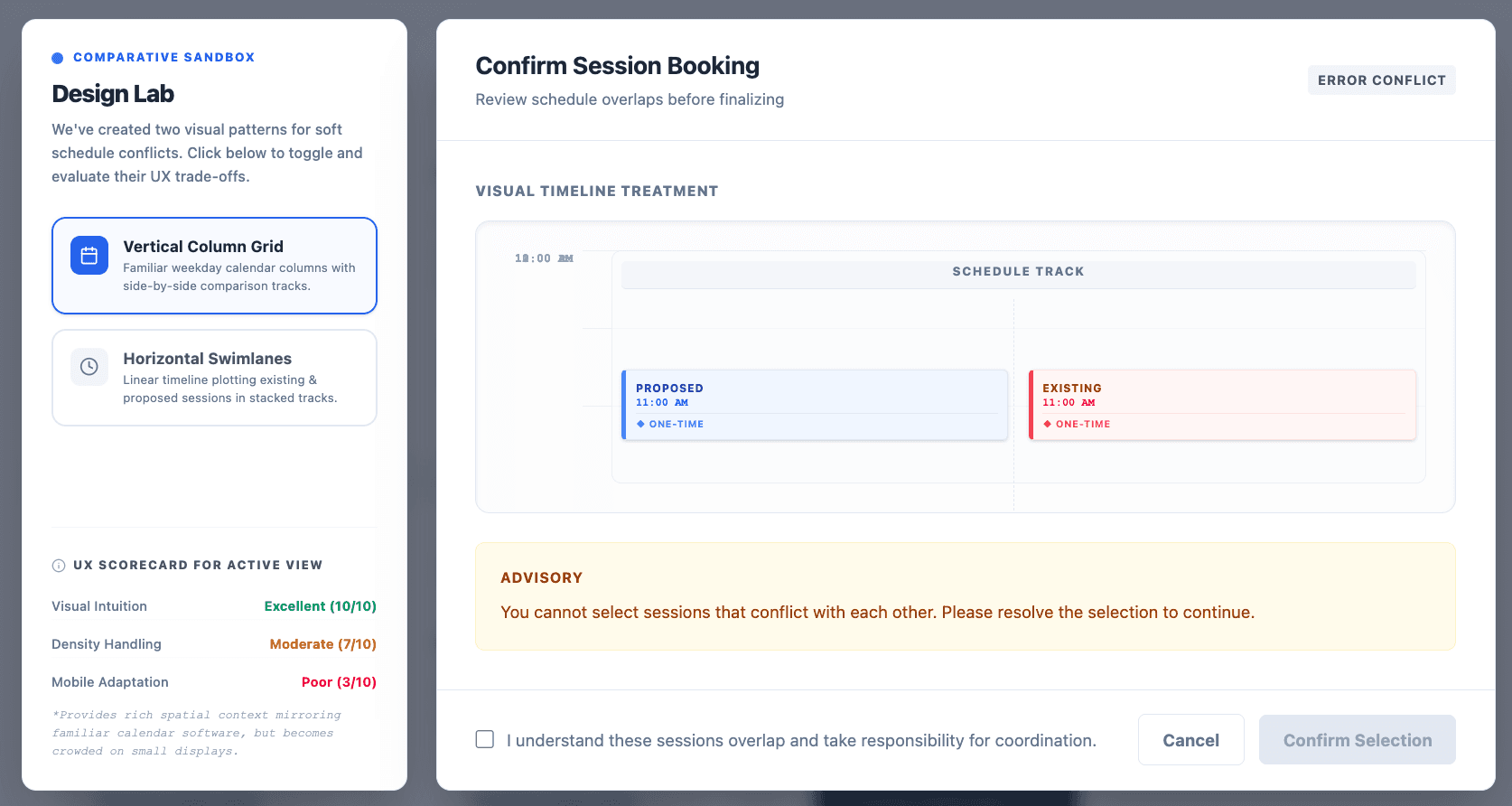
Selection error
Used when selected sessions conflict with each other — for example, a tutor selects two fill-ins that overlap in time.
Unlike other warnings, this scenario cannot be resolved through confirmation because both commitments cannot be fulfilled.
Defining overlap severity
To create consistent guidance across all scenarios, overlap duration became the primary indicator of risk.
Minor overlap
- Allow sign-up
- Display warning
- Require acknowledgment
Major overlap
- Escalate warning severity
- Flag for supervisor review
- Potentially restrict sign-up depending on policy
Explorations
AI-assisted ideation
Before moving into wireframes, I used Google AI Studio as a collaborative ideation tool to rapidly explore multiple approaches for communicating scheduling conflicts. Rather than generating a single solution, I used AI to help expand the design space by exploring:
- Warning and notification patterns
- Timeline-based conflict visualizations
- Ways to communicate overlap severity
- Confirmation and decision-making flows
Reviewing these explorations helped me quickly identify promising directions, compare trade-offs, and uncover edge cases that may have otherwise been overlooked.
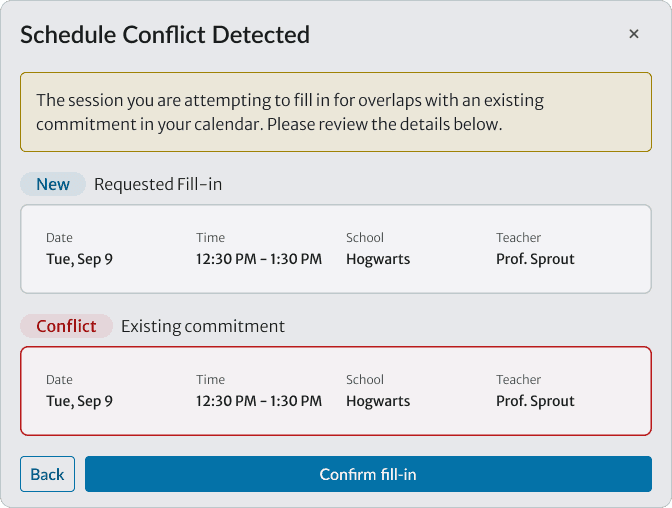
Final Design
Outcome
Blocking behavior
Supporting informed decision-making
By replacing hard restrictions with contextual guidance, the design reduces accidental overlaps while preserving the flexibility tutors need to cover sessions in real-world situations.
Retrospect
With more time I’d like to
- Measure the impact on call-off request volume.
- Test whether warning severity affects tutor behavior.
- Explore timeline visualizations that communicate conflicts even more clearly.